Cambodia
Much like many other developing countries, Cambodia faces many challenges and struggles to deliver a high-quality education to its youth. Although the net enrollment rate in primary school is high at 93%1, the number drops dramatically once students reach secondary schools where enrollment is less than 40%. In addition, the public school system has been competing with the rise of the private school sector, which has been draining middle class students from state schools. For example, in 2016, 119 private primary schools were operating in Phnom Penh, the capital city, in comparison to 164 public schools. These private schools not only cater to the Cambodian elite, but also undermine the credibility of state schools, where accountability for professional behaviour is weak. The lack of accountability in the state schools has facilitated the emergence of an exam-driven shadow education system that discriminates against poor students who cannot pay for private classes. Students in the state perform poorly on national examinations in spite of significant (but unconditional) investment from the international banks and bilateral donors2.
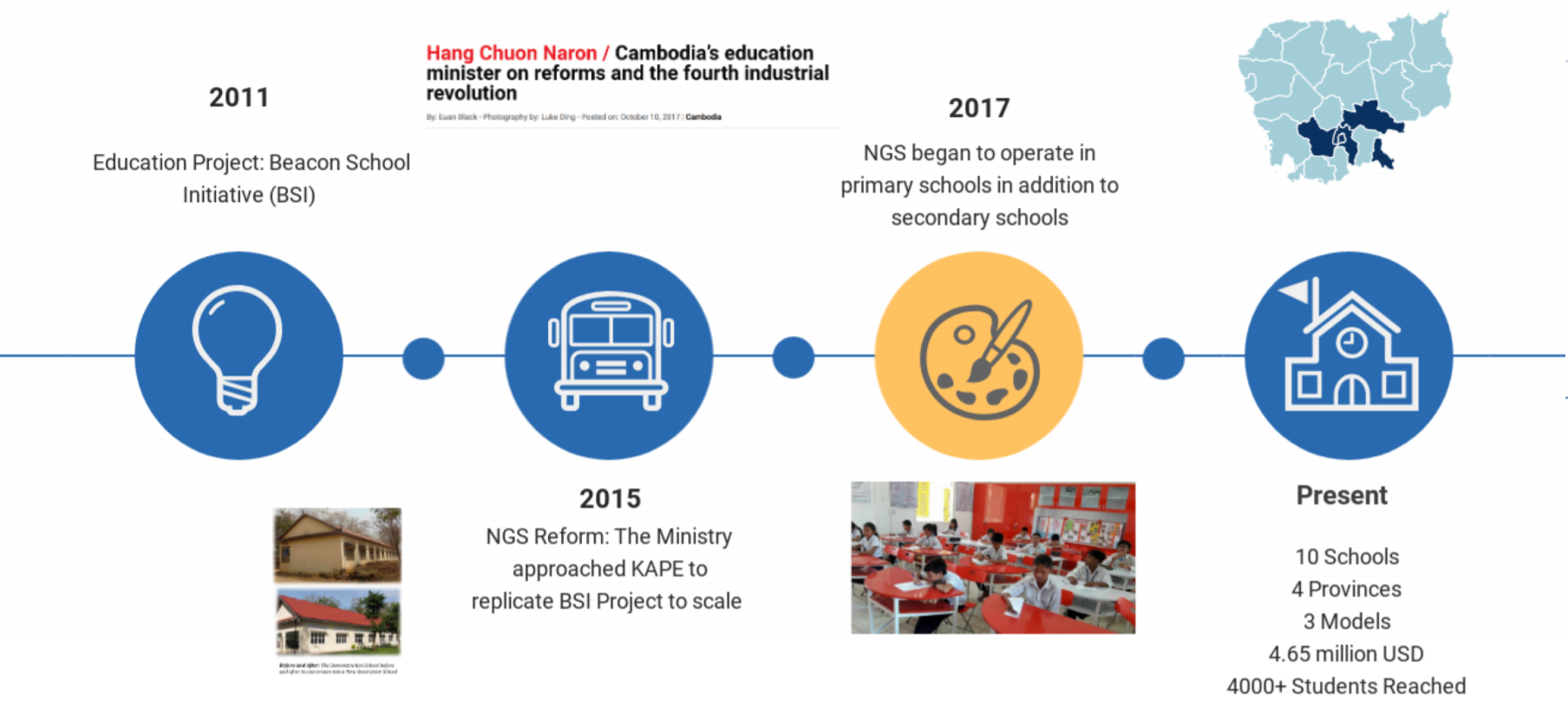
The New Generation School approach, known in its early years as Beacon Schools, was originally piloted in a region of Cambodia under the auspices of a local NGO called Kampuchea Action to Promote Education (KAPE) (2011-2015). There were originally three Beacon schools in the original pilot of the programme but for varying reasons two of the three schools, failed. Many useful lessons were learned and the model over time improved to the extent that despite initial government ambivalence towards the program the Ministry of Education, Youth, and Sport (MOES) started to engage with the program. Under the leadership of the Minister of State for Education MOES became and active supporter of the program, taking the unprecedented step of funding the programs expansion to 12 schools. The commitment of the government to this model has been notable and is the first time the Ministry has ever funded a non-state actor. These reforms have since been endorsed by the Prime Minister and Parliament and incorporated into the Kingdom’s Strategic National Plan. The New Generation School system has effectively dealt with the problem of teacher corruption and shadow teaching, leading to a return of many middle class children to the state schools. These trends have helped to push back against the stratification of the education system into separate schools for rich and poor.
There are now many metrics demonstrating the success of New Generation Schools including high performance on the National Exit Examination(90% pass rate), high transition rates to tertiary education institutions (88%), and successful competition in both national and international contests. The new found popularity of New Generation Schools among parents has now required the introduction of entrance examinations since demand now exceeds supply. The demand for these public schools among parents is itself a measure of their success and perceived higher standards. As of 2020, enrolment in New Generation Schools now exceeds 5,000 children who are receiving a high-quality education with extended hours of learning, modern science labs, libraries, computer facilities and excellent English language learning opportunities.
The Cambodian government is now considering expanding New Generation Schools with a goal of having at least two schools in each of the Kingdom’s 25 provinces and municipalities. An important step in this direction was made when the Ministry of Education, Youth, and Sport expanded its funding to KAPE to set up a New Generation Pedagogical Research Center at the National Institute of Education. This new center is tasked with expanding the pool of human resources who can support existing New Generation Schools and staff new schools in new provinces.
1. Education Management Information System (2017), Phnom Penh: MoEYS.
2. Bredenberg, K. (2020), Progress with Reforming Secondary Education, in ‘Education in Cambodia: From
Year Zero to International Standards,’ MacNamara, V. (ed.), Singapore: Springer Press (in press).